Excited to share a preprint from my postdoc work in
Shipman’s lab!
We developed Detectrons — programmable biosensors that convert RNA signals into stable DNA barcodes inside living cells, enabling multiplexed RNA sensing. 🧵👇
biorxiv.org/content/10.6...
biorxiv.org
Jihoon Han
New review out! Bacterial pathogens diversify to survive during infection - using bet-hedging and division of labor to generate specialized subpopulations. We explore how host signal actively drive this process
www.sciencedirect.com/science/arti...
🤖 Announcement for Opentrons users - OT-2 & Flex 🤖
We developed Slowpoke, an open-source, automated Golden Gate cloning tool with Fankang Meng & @proftomellis.bsky.social at @imperialcollegeldn.bsky.social
Flex-optimisation by @gregorybatt.bsky.social at @pasteur.fr
👉 pubs.acs.org/doi/10.1021/...
One of the biggest challenges in microbial biotechnology? Unlocking the potential of non-model microbes and synthetic communities! Glad to share our review @sonjablasche.bsky.social @simonemozzachiodi.bsky.social @kiranrpatil.bsky.social @cambridgebiosci.bsky.social🧵(1/7) doi.org/10.1016/j.co...
Phenotypic heterogeneity within isogenic bacterial populations represents a fundamental adaptation strategy that enables pathogen survival across the …
www.sciencedirect.com
In synthetic biology, DNA assembly is a routine process where increasing demands for standardization, high-throughput capacity, and error-free execution are driving the development of accessible, auto...
A new paper in Science measured the prevalence of social sycophancy across 11 leading large language models. The model’s responses were nearly 50% more sycophantic than humans’, even when users engaged in unethical, illegal, or harmful behaviors.
www.science.org/doi/10.1126/...
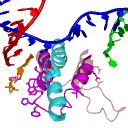
Just amazing what evolution can come up with. Naturally occurring nuclease deficient Cas12 family members use gRNAs to bind DNA and recruit sigmaE family members that drive txn initiation proximally. 2 papers! 1- describes 2- structure!
www.nature.com/articles/s41... www.nature.com/articles/s41...
The ERC's new white paper examines the gap in participation and success rates between Europe’s strongest research systems and a group of countries performing less well. It also calls for coordinated efforts at national and European level.
Read more: erc.europa.eu/news-events/...
How diverse is bacterial immunity ?
We report in @science.org how language models allowed us to predict 2.4M antiphage proteins spanning >23K novel potential systems.
👏 @emordret.bsky.social, @alexhv.bsky.social & al doi.org/10.1126/scie...
Explore them here defensefinder.mdmlab.fr/wiki/refseq_...
Camilla Ciolli Mattioli
Indra Roux
www.science.org
Specialized σ factors interact with nuclease-dead, CRISPR–Cas12f proteins to form potent, RNA-guided gene activation systems that function independently of fixed promoter motifs.
“Academic science is not only about productivity, it is also about deep understanding, exploring creative solutions and training critical thinkers to be the next generation of researchers.”
www.nature.com/articles/d41...
Jay Van Bavel, PhD
European Research Council (ERC)
Craig Kaplan
Aude Bernheim
Artificial intelligence is rapidly accelerating scientific output, but risks narrowing inquiry, weakening judgement and undermining how scientists are trained.
High-throughput engineering of ligand-activated splicing ribozyme through domain insertion https://www.biorxiv.org/content/10.64898/2026.05.21.726912v1