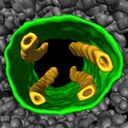
It’s done!! Molecular architecture of the ciliary base in mammalian multiciliated cells! A study 13 years in the making 👴, thanks to collab with @stearnslab.bsky.social + @centriolelab.bsky.social & visionary work by @computingcaitie.bsky.social, who integrated native #cryoET with #XLMS & #UExM 🧪🧶🧬🔬
Crazy things have been happening in cilia world, catch up on them in Caitie's new paper! 🪱
The 14th International Conference for Plant Mitochondrial Biology😍🍜🍀
My first trip to Japan and my first presentation award!
Many thanks to the organizers, my supervisor, @florentwaltz.bsky.social, and our wonderful collaborators!
I was happy to present my work in beautiful Kagoshima🌋
To supplement our cryo-ET and generate candidates for proteins that localize to different ciliary regions, we took a trip to the local butcher to pick up some cow trachea to build a mammalian multiciliated cell interactome using XL/MS (enjoy this vid of @cellarchlab.com shaking cilia off trachea)
MissAlignment is out!!! Our new software that improves reference-free tilt series alignment by mimicking human intuition. Check out Dimitry's beautiful thread for a quick summary!
And the preprint for more details: www.biorxiv.org/content/10.6...
The program: github.com/warpem/miss-...
1/ Excited to share our preprint! 🥳
Degradation of aromatic compounds, including BTEX pollutants, requires highly endergonic aromatic ring reduction. Using #cryoEM and in situ #cryoET, we show how BCRII couples electron bifurcation modules in one giant redox machine
www.biorxiv.org/content/10.6...
We're super excited to share MissAlignment: a new ML-based approach to reference-free tilt series alignment, spearheaded by @martenchaillet.bsky.social. We think it's going to make your cryo-ET life a lot better.
Preprint: www.biorxiv.org/content/10.6...
Code: github.com/warpem/miss-...
🧶 Thread:
“the best way to work with cryoET data is to engage with it directly, […] build familiarity with what is actually there. As tempting as it sometimes is to lean in to automation entirely, we cannot do visual proteomics by relying blindly on automation.”
mgflast.github.io/easymode/use...
Video
Video
Video
Postdoc opportunity at FMI + Novartis Biomedical Research 🧬
The Dahmane lab (FMI) & Farady lab (Novartis) are seeking a postdoctoral researcher to study how extracellular inflammasome particles propagate inflammation during neurotropic RNA virus infection. Apply by May 31: www.fmi.ch/education-ca...
Ben Engel
Oxygen gradients reshape cross-feeding through emergent spatial organization of gut commensal bacteria
www.biorxiv.org/content/10.6...
Use of isotope labels and cryo-CLEM-FIB-SIMS to study microbial communities by Hannah Ochner. Collaboration with @kiranrpatil.bsky.social @jmghigolab.bsky.social
Microbial interactions unfold within environments structured by physical transport and chemical gradients. Yet most mechanistic studies rely on well-mixed systems that mask the reciprocal influences of environmental heterogeneity on metabolism and ecology. Here, we investigate how the physical environment modulates the interaction between the gut commensal Bacteroides thetaiotaomicron and Escherichia coli . In anoxic liquid culture, cell-resolved isotope imaging and genetic perturbations reveal exploitative cross-feeding, where E. coli consumes diffusible sugars released by B . thetaiotaomicron during starch degradation. When exposed to intestinal-like oxygen gradients in microfluidics, the interaction is restructured by spatial organization. The species self-organize into complementary niches: E. coli locally depletes sugars and oxygen, thereby expanding the anoxic niche required by B. thetaiotaomicron . A reactive transport model confirms that this organization arises from coupled feedback between physical transport and metabolic reaction rates. Together, our results reveal how physical structure and chemical gradients convert an exploitative cross-feeding interaction into a dynamic niche-construction process that generates emergent spatial organization and stabilizes coexistence. ### Competing Interest Statement The authors have declared no competing interest.
www.biorxiv.org
I am excited to share our most recent work collaborating with @centriolelab.bsky.social and @stearnslab.bsky.social to look at the ciliary base of mammalian multiciliated cells w/ cryo-ET, XL/MS, and U-ExM www.biorxiv.org/content/10.6...
I am excited to share our most recent work collaborating with @centriolelab.bsky.social and @stearnslab.bsky.social to look at the ciliary base of mammalian multiciliated cells w/ cryo-ET, XL/MS, and U-ExM www.biorxiv.org/content/10.6...
Marten Chaillet
Tomas Pascoa
We're super excited to share MissAlignment: a new ML-based approach to reference-free tilt series alignment, spearheaded by @martenchaillet.bsky.social. We think it's going to make your cryo-ET life a lot better.
Preprint: www.biorxiv.org/content/10.6...
Code: github.com/warpem/miss-...
🧶 Thread: