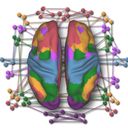
We present the LARGEST normative model of the brain’s white matter microstructure: 54,583 subjects, 4-91 yrs, 19 datasets. We derived lifespan centile curves for DTI FA, MD, RD, AD, detecting anomalies for dementia, and Mild Cognitive Impairment: doi.org/10.1038/s414... ⤵️
Our new preprint is out! We examined the associations between multimodal brain measures (structure, microstructure, function) and psychopathology domains to predict adolescent functioning using the ABCD Study. In collab with @yiplab.bsky.social and co!
Excited that Imaging Neuroscience has gotten its impact factor. Note that the impact factor is artificially low for the first year of any journal (because of the way it is calculated), so we expect the impact factor to improve next year. See more statistics below
If you are looking to pursue a doctoral program, postdoc position, or postbac role, and interested in computational neuroscience broadly, @elbusch.bsky.social 's lab would be a great stepping stone! She is a great scholar with an interdisciplinary focus. Plus, she has a very cute dog named Junie!
Join us on Monday, June 8, to learn about the progress the 2025 @kavliatyale.bsky.social Awardees have made on their Kavli-funded research projects 🧠. Open to all Yale affiliates.
🧬 @zhenlei.bsky.social 🖥️ @clionamurray.com 🔡 @jivr.bsky.social 🦠
Excited to be at #ohbm2026 @ohbmofficial.bsky.social presenting our real-time fMRI paper just published in @natneuro.nature.com ! come learn more at my talk on Wed at 9am in the symposium on “Closed-loop fMRI Neurofeedback” in Room E
Our new paper is out this week in Nature Neuroscience! www.nature.com/articles/s41... We built a BCI that works with the brain's natural geometry — and we found that people could learn to play a video game with their brains in <1 hr of training. This efficiency is groundbreaking & here's why:
🔦 Speaker Spotlight: Angela Laird, Ph.D.
🎤 Reliability Across the Eras: From Early Discoveries to Population Neuroscience
🧠 Pioneer in neuroimaging meta-analysis (ALE, NiMARE, Neurosynth), shaping how we synthesize brain data at scale.
🔗 www.humanbrainmapping.org/2026-feature...
What matters most for childhood brain organization?
We analyzed 649 variables.
The answer: Socioeconomics (SES); with brain patterns pointing at sleep & stress as drivers.
Even brain-IQ associations were better explained by SES.
In Science today: www.science.org/doi/10.1126/...
So glad to finally share work years in the making! What started with fMRI effect size benchmarks ended up showing that conventional study planning detects ~half of expected brain effects, suggesting more distributed processes than the lit shows
(+ new methods for mass univ effect/power estimation)
Busch et al. use nonlinear neural manifolds to help humans gain rapid control over a noninvasive brain–computer interface, allowing them to learn how to play a video game with real-time fMRI neurofeed...
🎉🎉🎉🎉 I'm thrilled and humbled to share some major updates! (A 🧵 but TLDR: graduated from Yale, joining Sungkyunkwan University in South Korea as an IBS Young Scientist Fellow this summer, and starting as an assistant professor in Vanderbilt's College of Connected Computing in Fall 2027!)
The Organization for Human Brain Mapping
Distinct associations between multimodal brain measures and psychopathology domains predict adolescent functioning https://www.biorxiv.org/content/10.64898/2026.06.03.729937v1