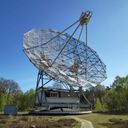
We're still tracking #Artemis II with the Dwingeloo radio telescope, with four very enthousiastic amateurs staying up all night in the control room. We just witnessed the Orion upper stage separation burn in our doppler tracking.
Tracking #tianwen2 for a few days, we see that the Chinese spacecraft is clearly getting closer to the asteroid Kamo'oalewa. According to online rumors (see wikipedia's reference to a post from Andrew Jones), it would arrive 7 June 2026. That seems consistent with our observations so far.
The Dwingeloo telescope is currently tracking the Chinese spacecraft Tianwen-2, which is on its way to asteroid Kamo'oalewa. We're live streaming our reception to websdr.camras.nl:8901?tune=8428158
With the 25m Dwingeloo radio telescope, we just tracked #Tianwen-2 on X-band. It was at an offset of 1.1 degrees from asteroid Kamo'oalewa, which it is going to visit. We recorded IQ data, maybe others can decode this (@destevez.net, @aang23.satdump.org?). Data at data.camras.nl/satellites/r....
Using the Dwingeloo telescope (which predates spaceflight!) we are tracking the carrier frequency of #Artemis II. Maneuvers cause slight changes in that frequency. We annotated the timestamps of Day 1's proximity operations demonstration and we are measuring velocity changes of just a few m/s!
CCSDS 8192-bits CADUs, RSS 223/255 I=4
We just observed the Return Trajectory Correction Burn 2 of #Artemis II in Doppler tracking. We saw a ~3 Hz jump, corresponding to a line-of-sight velocity change of about 0.4 m/s.
websdr.camras.nl
We think a Tianwen-2 manoever happened early 7 June, as expected. With the Bochum telescope (@amsat-dl.org) and the Dwingeloo telescope, we observe that a) Tianwen-2 is close to the asteroid on the sky and b) the change in the line-of-sight velocity (Doppler) now almost matches that of the asteroid.
Radiotelescoop Dwingeloo
Radiotelescoop Dwingeloo
Radiotelescoop Dwingeloo
Radiotelescoop Dwingeloo
Radiotelescoop Dwingeloo
Aang23
Radiotelescoop Dwingeloo
Radiotelescoop Dwingeloo
With the 25m Dwingeloo radio telescope, we just tracked #Tianwen-2 on X-band. It was at an offset of 1.1 degrees from asteroid Kamo'oalewa, which it is going to visit. We recorded IQ data, maybe others can decode this (@destevez.net, @aang23.satdump.org?). Data at data.camras.nl/satellites/r....
It's the anniversary of the Dwingeloo radio telescope: it was opened by Queen Juliana on 17 april 1956. We celebrated this during the lunch break by reenacting the opening ceremony, with Roelie as her majesty and Michel as Professor Oort. We used the original button, which we recently rediscovered.
Radiotelescoop Dwingeloo
Radiotelescoop Dwingeloo
New blog post: Decoding Tianwen-2. I analyze the telemetry decoded from recent @radiotelescoop.bsky.social recordings of Tianwen-2. Compared to Tianwen-1, there is not much in the telemetry. There are not that many fields and most are mainly static. Read more: destevez.net/2026/05/deco...