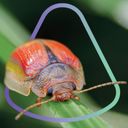
The #EditorsChoice article for the issue discusses how #moth communities are shaped by season, weather, elevation, and landscape composition
doi.org/10.1111/icad.12835
#Biodiversity #InsectCommunities
@felixneff.bsky.social @agroscope.bsky.social @vogelwarte.bsky.social
Photo credit: Felix Neff
Interested in nocturnal #moths?
☑️ Check our new BE-Paper in @oikosjournal.bsky.social:
#Land-use intensification reduced trait & phylogenetic beta #diversity - mainly in common moths. Rare #forest species responded differently. Body size ↓, wing load & darkness ↑.
🔗 doi.org/10.1002/oik.... 🌐
The first study to survey insect populations on a continental scale finds no evidence of widespread decline, at least over a recent 10-year period. https://scim.ag/4pnb6hN
„The fall of a prolific science journal exposes the billion-dollar profits of scientific publishing“ 🧪🎓
english.elpais.com/science-tech...
Many of my colleagues in ecology will know the name of the journal:
Science of the total environment (STOTEN)
🌱 #Biodiversität in der #Schweiz: Der Zustand bleibt ungenügend. Trotz verlangsamtem Rückgang besteht grosser Handlungsbedarf. Unser neuer datenbasierter #Report zeigt #Fakten, Entwicklungen und Lösungsansätze 👉 biodiversitaet2026.ch #Wissenschaft #Forschung
New study on arthropod declines @natecoevo.nature.com 🪲
In two time series @jena-experiment.bsky.social & @bexplo.bsky.social we show how community (dis)assembly underpins local biomass declines.
It mostly boils down to species loss, with identity losing relevance.
www.nature.com/articles/s41...
Check out the publication in @natecoevo.nature.com here: www.nature.com/articles/s41...
#insects #landuse #climate #timeseries #lepidoptera #coleoptera
@agroscope.bsky.social @wslresearch.bsky.social @vogelwarte.bsky.social @unibas.ch @usyseth.bsky.social @ebdonana.bsky.social
📄Out now 📄:
90-year trends in Switzerland show declines in butterfly and saproxylic beetle richness around the mid-20th century, linked to agricultural mechanisation. Some groups have recovered in recent decades, especially warm-adapted species. Specialised and cold-adapted species remained low.🦋🪲
Thrilled to announce the publication of the trophiCH database: a multi-trophic, species-level #metaweb for #Switzerland🇨🇭
Out now in #ScientificData 📃 www.nature.com/articles/s41...
Want to explore the dataset? 🔍 webapps.wsl.ch/trophiCH/
#OpenData #Ecology #FoodWebs 🌐
1/6
🚨 Hot off the press! We show that species loss from key habitats (like wetlands) accelerates secondary extinction in regional multi-habitat food webs. Also, we show the importance of common species to regional food web robustness. doi.org/10.1038/s420...
#Ecology #FoodWebs #Biodiversity #Metaweb
Video
Study of continental U.S. sees stable population of bugs, but it may be missing important pieces of the puzzle
scim.ag
One of the 15 publications that put out the most studies globally has been expelled from the indexing system for irregularities. Its publisher, Elsevier, has a 38% profit margin that reached $1.5 bill...
Assessing the magnitude and drivers of recent biodiversity losses requires informative, long-term baseline data. Here the authors reconstruct the temporal trajectories of butterflies and saproxylic be...
Simulating extinctions across regional food webs reveals that losing species from one habitat— especially wetlands—can cascade to others, accelerating multi-habitat food web collapse, highlighting the...
Insects are declining in many regions. Here the authors show that arthropod biomass losses in Jena Experiment and Biodiversity Exploratories time series are driven more by species loss than by species...
📢 Over 90% of local insect biomass decline in German grasslands is explained by species loss.
“By the end of the study period, species loss, regardless of rarity or size, had become the main driver of decline”, says @bmwildermuth.bsky.social of #iDiv and @uni-jena.de
www.idiv.de/majority-of-...
A new study shows that over 90% of insect biomass declines are driven by shrinking species numbers, posing a risk to ecosystem function.