New paper showing that much of the apparent success of protein language models in predicting mutational effects is a mirage: These models mostly memorize sites. 1/
www.biorxiv.org/content/10.6...
New OpenFold3 preview out! (OF3p2)
It closes the gap to AlphaFold3 for most modalities.
Most critically, we're releasing everything, including training sets & configs, making OF3p2 the only current AF3-based model that is functionally trainable & reproducible from scratch🧵1/9
Amazing paper. A megadalton enzyme complex that:
- combines both electron bifurcation AND confurcation steps
- has a new type of iron-sulfur cluster
- a new kind of weird electron transfer path
- super charges electrons to reduce aromatic rings
- also powers respiration
😳
One of biggest mysteries in biology: how did complex eukaryotic cells evolve from simple microbes? ~1.8 billion years ago, an archaeal cell likely merged with a bacterium to form the first eukaryotic cell, but can we ever find direct evidence of this transformative event? 🦠 🚶♂️
AlphaFold database has entered the era of complexes. Together with NVIDIA, DeepMind and EBI, we use ColabFold, OpenFold and MMseqs2-GPU to predict ~31 million complexes (homo & hetro-dimers) resulting in 1.8 million high-quality predictions
📄 research.nvidia.com/labs/dbr/ass...
🌐 alphafold.ebi.ac.uk
1/ Excited to share our preprint! 🥳
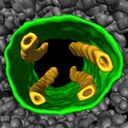
Degradation of aromatic compounds, including BTEX pollutants, requires highly endergonic aromatic ring reduction. Using #cryoEM and in situ #cryoET, we show how BCRII couples electron bifurcation modules in one giant redox machine
www.biorxiv.org/content/10.6...
Really excited that this major work from my PhD is finally published in @plosbiology.org ! In it, we were trying to tackle a fundamental question in evolution - how do genetic mutations map onto evolutionary fitness? (1/n)
journals.plos.org/plosbiology/...
This has been up for a while but I haven’t really publicized it. Introducing ciMIST: sparse, self-consistent network models of local and global protein conformational entropy, learned from molecular dynamics. This helps with analyzing MD and connecting to experiments
www.biorxiv.org/content/10.1...
Found out today that @kyclark.bsky.social has made their great 'Mastering Python for Bioinformatics' book into a YouTube series.
youtube.com/playlist?lis...
Having a hard time keeping up with the fast-moving field of origin of eukaryotes/Asgards archaea? Our new perspective article can help, we review the status of research over the last decade and where it's going.
The archaeal roots of eukaryotic life
www.pnas.org/doi/10.1073/...
Video
Video
www.biorxiv.org
Predicting the effect of a genetic mutation on fitness is a major challenge in evolutionary biology. This study uses fitness effects of a large collection of adaptive yeast mutants in multiple lab env...
Mastering Python for Bioinformatics (O'Reilly, 2022) by Ken Youens-Clark demonstrates how to write effective Python code and how to use tests to write and re...
Across scales from cells🦠 to atoms⚛️ – We reveal how anaerobic #bacteria break down very stable aromatic compounds found e.g. in oil spills 🛢️ #Bioremediation #TeamTomo 🧪 🧶🧬 🔬
Awesome collab with Lena, Matthias, @schullerjm.bsky.social @rnfr2d2.bsky.social @tomaspascoa.bsky.social @tamb-o.bsky.social
Video
Ben Engel
1/ Excited to share our preprint! 🥳
Degradation of aromatic compounds, including BTEX pollutants, requires highly endergonic aromatic ring reduction. Using #cryoEM and in situ #cryoET, we show how BCRII couples electron bifurcation modules in one giant redox machine
www.biorxiv.org/content/10.6...