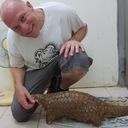
蛇年快乐! Happy New Year of the snake, with Tanystropheus, a long-necked Triassic reptile
In honor of Baron Ferenc Nopcsa, the renowned dinosaur researcher and former director of the Geological Institute of Hungary, the SZTFH/SARA is organizing a memorial day.
The event will take place in Budapest on October 2, 2025.
Registration and program flyer: hugeo.hu/en/form/nopc...
Penguins may look charmingly awkward on land, but new research shows their bodies are finely tuned for powerful, efficient movement both on land and underwater. Penguins “fly” underwater and their bodies have adapted accordingly.
Hirsh et al.: anatomypubs.onlinelibrary.wiley.com/doi/10.1002/...
"After the fall of the Roman Empire, elephants virtually disappeared from Western Europe. Since there was no real knowledge of how the animal looked, illustrators had to rely on oral and written transmissions to morphologically reconstruct the elephant" www.uliwestphal.de/elephas-anth...
Our work with Zsófia Román (my former MSc student) is now published in @historicalbiology.bsky.social , Volume 37, Issue 3. In this paper, we have analyzed a particularly rich coprolite material using different methods to explore its paleoecological significance. 💩 🐟 🦭
It was a great honor and an adventure to work together with @camillebader.bsky.social on this unique Deinotherium limb bone. The analysis helped us better understand how the inner structure of this giant’s bones adapted to its enormous size. (Art: Tibor Pecsics - @griffworkshop5)
Feel free to contact me if you wish to get the PDF! www.tandfonline.com/doi/abs/10.1...
🦴 How do proboscidean bones support such massive weight?
Chapter 3 of my PhD is out, a new paper diving into their bone microanatomy!
With Alexandra Houssaye @houssayecnrs.bsky.social and John R. Hutchinson @johnrhutchinson.bsky.social
academic.oup.com/zoolinnean/a...
Out in @nature.com today, we shake up the ornithischian family tree. Remember those weird Late Cretaceous iguanodontians, the rhabdodontids? Well they're weird because they aren't iguanodontians. They're ceratopsians. Well, at least some of them are... www.nature.com/articles/s41...
The backstory of this important bone was forgotten. However, we were able to identify it in archival photographs and an old newsreel clip from 1961 (from 0:39, filmhiradokonline.hu/watch.php?id...), which helped us determine its place of origin and find several related fragments.
Natalia Jagielska (娜塔莉)
Thousands of coprolites have been collected from the Upper Miocene (Tortonian/Pannonian) sands of the Pécs-Danitzpuszta sand pit, one of the most important mixed Neogene vertebrate localities in Hu...
www.tandfonline.com
Thousands of coprolites have been collected from the Upper Miocene (Tortonian/Pannonian) sands of the Pécs-Danitzpuszta sand pit, one of the most important mixed Neogene vertebrate localities in Hu...
New results indicate that rhabdodontids and the previously described Ajkaceratops are actually distinctive European ceratopsians, a group better known from Asia and North America.
It was a great honor and an adventure to work together with @camillebader.bsky.social on this unique Deinotherium limb bone. The analysis helped us better understand how the inner structure of this giant’s bones adapted to its enormous size. (Art: Tibor Pecsics - @griffworkshop5)
New paper out in Geodiversitas! 🦣🦴
Ever wonder what the inside of Deinotherium giganteum looks like? Find out about it here:
geodiversitas.com/48/7
Big thanks to the Budapest HNHM for providing access to this unique material! With Prof. Mihaly Gasparik & @segesdimartin.bsky.social
Martin Segesdi
Oh! Another paper! From @camillebader.bsky.social Camille Bader's PhD, with Alexandra Houssaye @houssayecnrs.bsky.social. Elephant limb bone microanatomy reflects bone function and posture.
Paper:
academic.oup.com/zoolinnean/a...
Tons of CT scan DICOM files:
figshare.com/articles/dat...
Bone anatomy reflects the mechanical and functional constraints to which the skeleton is subjected. In graviportal taxa, the primary constraint is gravity, requiring specific adaptations in bone struc...
geodiversitas.com
New paper out in Geodiversitas! 🦣🦴
Ever wonder what the inside of Deinotherium giganteum looks like? Find out about it here:
geodiversitas.com/48/7
Big thanks to the Budapest HNHM for providing access to this unique material! With Prof. Mihaly Gasparik & @segesdimartin.bsky.social
Abstract. One of the greatest challenges of terrestrial locomotion is resisting gravity. The morphological adaptive features of the limb long-bones of exta
Bone anatomy reflects the mechanical and functional constraints to which the skeleton is subjected. In graviportal taxa, the primary constraint is gravity, requiring specific adaptations in bone struc...