Professor @ UMich. Research making health & risk data communications intuitively meaningful, narratives, improv. Editor-in-Chief of Medical Decision Making & MDM Policy & Practice. Opinions my own.
Brian Zikmund-Fisher
Almost a decade ago, I wrote a piece for TheConversation.com on the (manageable) risks of raw cookie dough (theconversation.com/why-public-h...). It went viral and has something like 400k views. But, the world of dough has changed, so it seemed like a good time for a revision. Enjoy!
Brian Zikmund-Fisher
I've published literally hundreds of studies, but this one will always be special. I'm so proud to have helped Dr. Cathryn Lapedis show so convincingly how BAD current prostate biopsy pathology reports are compared to a simple patient-centered design. PLUS: my first JAMA article ever!
Cannot overstate the importance of this idea: Patients need appropriately selected comparisons in order to understand the meaning of their health data. Great work @ellenpeters.bsky.social !
Great discussion by my colleague @kaytesb.bsky.social on what actually happens to direct-to-consumer genetic testing data.
Very proud of authoring this JAMA piece summarizing the most evidence based recommendations we have about communicating probabilities and test results to patients. Now to hope that people believe that using these best practices matters!
Brian Zikmund-Fisher
Great to see my friend and colleague @ldscherer.bsky.social and Kirsten McCaffery from @sydneyhealthlitlab.bsky.social in today's New York Times talking about how calling something "cancer" may not be helpful for decision making about DCIS!
Tagging @smdm.bsky.social for amplification.
The Making Numbers Meaningful Systematic Review papers are now available! Review of 316 papers on communicating health-related probabilities to the public. 1,119 findings. Methods / scoping paper, 6 evidence summary papers, 5 editorials. All open access.
journals.sagepub.com/topic/collec...
Brian Zikmund-Fisher
Brian Zikmund-Fisher
Brian Zikmund-Fisher
Public health professor Brian Zikmund-Fisher breaks down the risks from raw eggs and flour in homemade dough—and explains why store-bought "ready to eat" options are now his go-to for satisfying cravi...
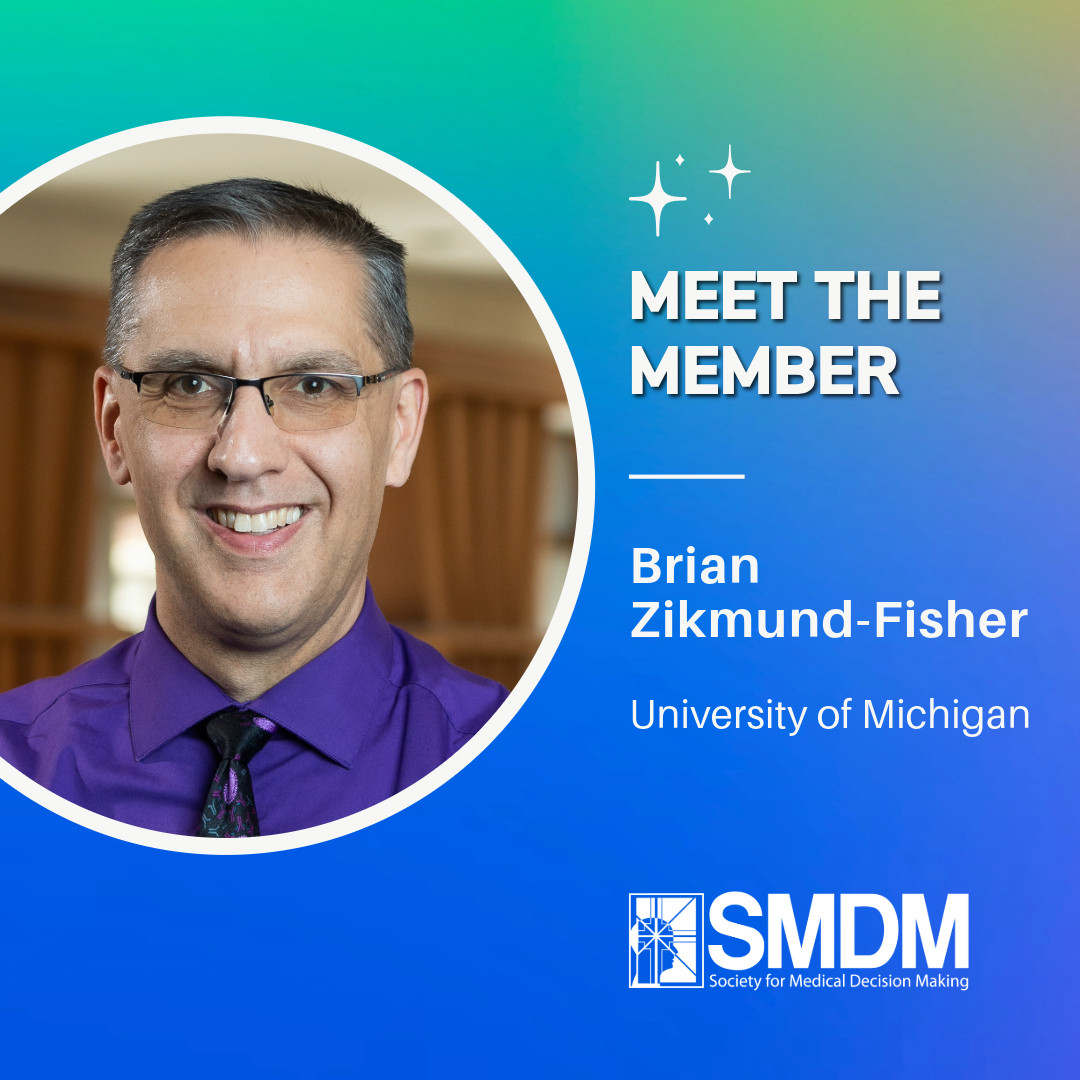
🎉 Meet the Member: Brian! 🎉
🧠 Area of Expertise: Risk Communication & Shared Decision-Making
🎭 Fun Fact: Uses improv theater games to enhance teaching, research presentations, and communication skills!
Brian has been an SMDM member since 2000 and deeply values its mentoring culture. 💙
Brian Zikmund-Fisher
Brian Zikmund-Fisher
💡 JAMA Insights: Numeric risk comparisons anchored in patient context may improve shared decision-making and help patients interpret clinical choices.
ja.ma/42qgUNS
Patient-centered pathology reports improved patients' understanding of prostate biopsy results and their ability to accurately assess their cancer diagnosis and risk level, compared to standard pathology reports.
ja.ma/4a3c38z
Society for Medical Decision Making (SMDM)
JAMA
Some oncologists suggest that, for certain early cancers not at risk of spreading, the term “cancer” should be avoided.
Clinicians can enhance patient understanding by using numerical data instead of verbal probabilities, consistent denominators, absolute risk comparisons, and clear context for unfamiliar data types.
ja.ma/4pAC3zi
Many who undergo direct-to-consumer genetic testing don’t realize that their data are being licensed to pharmaceutical and biotech companies.
JAMA Viewpoint authors @kaytesb.bsky.social and Anya E. R. Prince discuss this gap between consumer expectations and what is being done.
ja.ma/40uGL7q