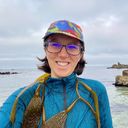
She/Her • Coral biology & intertidal ecology • Passionate about inclusive pedagogy, building community in academia, and isotope ecogeochemistry
Taylor Lindsay
Loading...
A neon goby (Elacatinus oceanops) rests upon a great star coral (Montastraea cavernosa)🪸
JUMBO announcement:
This week I started my Postdoc at Tufts University in the Rotjan Lab! Our research will explore the energetic trade-offs of facultative symbiosis in temperate corals up and down the Atlantic coast!
Bearded fire worms (Hermodice carunculata) may look soft and fluffy, but will actually leave you with a nasty sting if you get too close. These worms eat corals like the ones pictured here and can grow to be nearly 3ft long!
Very excited to be featured in this article all about the URI dive program and to share a little bit about my PhD research with our diving community!
www.uri.edu/magazine/iss...
🌊 Phylum Friday: Bryozoa! 🌊
These small colonial organisms are usually found encrusting rocks or blending in with algae. However, many of the species found in New England are invasive, and have become a concern for intertidal and subtidal ecosystems as they encrust and out-compete native species.
🌊 Phylum Friday - Urochordata 🌊 Tunicates come in colonial (many individuals living in a colony) & solitary forms and are filter feeders, pumping water through their two siphons to collect food. Fascinatingly, tunicates are closely related to vertebrates because they have a nerve cord as larvae.
🌊 Phylum Friday - Arthropoda! 🌊
This week’s pinchy pals are among the most diverse and most abundant group of organisms in the world! There are upwards of 70,000 species of crustaceans ranging from microscopic copepods to deep sea crabs to tropical shrimps to intertidal barnacles!
We found some awesome critters this week on our research cruise in the Gulf of Mexico!
Fascinating dive in a kelp forest to urchin barren transition zone yesterday in Monterey! 🌊🤿
Taylor Lindsay
Taylor Lindsay
Taylor Lindsay
Taylor Lindsay
Taylor Lindsay
Taylor Lindsay
Taylor Lindsay
Taylor Lindsay
🌊 Phylum Friday: Echinodermata - Urchins!! 🌊 While they may look scary, sea urchins are slow-moving herbivores that eat kelp and other algae. Urchins typically hide from light using their tube feet to hold on to shells, algae and detritus for shade and extra protection from predators!
Dr. Brooke Weigel
Taylor Lindsay
URI’s Diving Research and Safety Program helps ocean scientists unlock their living lab.