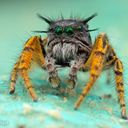
Spiders! Art?
most active on iNat: https://www.inaturalist.org/observations?place_id=any&user_id=tshahan
Thomas Shahan
Loading...
overlaying jumping spiders on insects at 50% opacity...
clockwise from top left:
salticid/caddisfly
salticid/moth
salticid/butterfly
salticid/barklouse
from the side...
bold patches of white setae break up the silhouette + create the illusion of a more tucked waist, additional body segment(s?) - maybe even a more isolated, ant-like head?
and a darker color around the rear eyes (~where an ants are) makes them look bigger!
lateral angle disguise ✅
bit better anterior angle - focused on the "antennae" - v anty 🐜
squinting eyes (and looking at the image small), taking in just values, u can def see the silhouette of an ant like head capsule too
anterior angle disguise ✅
Not the most colorful Habronattus out there but very handsome in an understated way - Habronattus borealis. One of the more common Habros I'll see around here (NE OK) on rocky shores of creeks and lakes in the summer.
low posterior angle passes the "looks like an ant" test too ✅
Camponotus with another ant's head still clamped to her left antenna. Second time I've seen this with this species (Camponotus pennsylvanicus?) this spring! Wild how the mandibles can still be locked so tightly even after the attacker was decapitated!
I see Peckhamia a lot and occasionally think "ooh this one looks a little different" but don't ID them to species because they're apparently difficult to tell apart and the genus needs revision
love that they're still kind of a mystery🙇
first two shots are closer shots of the ant above ^
....second two shots are of another Camponotus I shot in April with a past-attacker's head attached to leg III:
Clockwise from top left:
Nectopsyche sp. - White Miller Caddisfly
Petrophila jaliscalis - Jalisco Petrophila
Cyllopsis gemma - Eastern Gemmed-Satyr
Cerastipsocus trifasciatus - Barklouse
maybe the depicted salticid is at a low anterior angle: how real jumpers may encounter another face-to-face?