Trying to figure out what neurons do @biozentrum.unibas.ch @unibas.ch
Everton J Agnes
Work led by @sevberg.bsky.social and 100% made at the @biozentrum.unibas.ch supported by the @snsf.ch. doi.org/10.64898/202...
New preprint with @sevberg.bsky.social! We map Hopfield-like binary networks onto spiking networks with dendrites … and it works! Same memory capacity, bigger basins of attraction, plus selective recall through dendritic gating, and more. How? Dendrites! See below.
Everton J Agnes
Our framework can also be used to predict or create hypotheses about spiking and dendritic activity based on memory organisation. Fluorescence correlations between dendritic branches directly reveal how memory sets are organised. Each branch tells a different story.
These voltage fixed points act like the 0s and 1s of a Hopfield network, letting us map binary connectivity onto the spiking network. Same number of stored memories, but recall works from smaller and noisier cues!
The readout network stabilises the active memory set against interference. Partial cues recall memories within a set, but switching requires stronger input. The same circuit also resolves competition between highly overlapping memories from different sets (this only in the preprint).
To build our framework, we take advantage of the binary-like states of dendrites: hyperpolarised (down) and depolarised (up), both governed by EI balance that emerges from voltage-dependent synaptic currents.
There are two ways to control memory set accessibility: external or autonomous. To show that a feedback loop can do this, we built a system of connected networks. A readout network identifies which memory is being recalled and sends inhibition back to the dendrites that need shunting.
We don't need to stop at one dendrite per neuron. More branches means more memory sets, one per leaf dendrite. But we need control to select which set is recalled. The solution: precise shunting inhibition of specific dendritic branches.
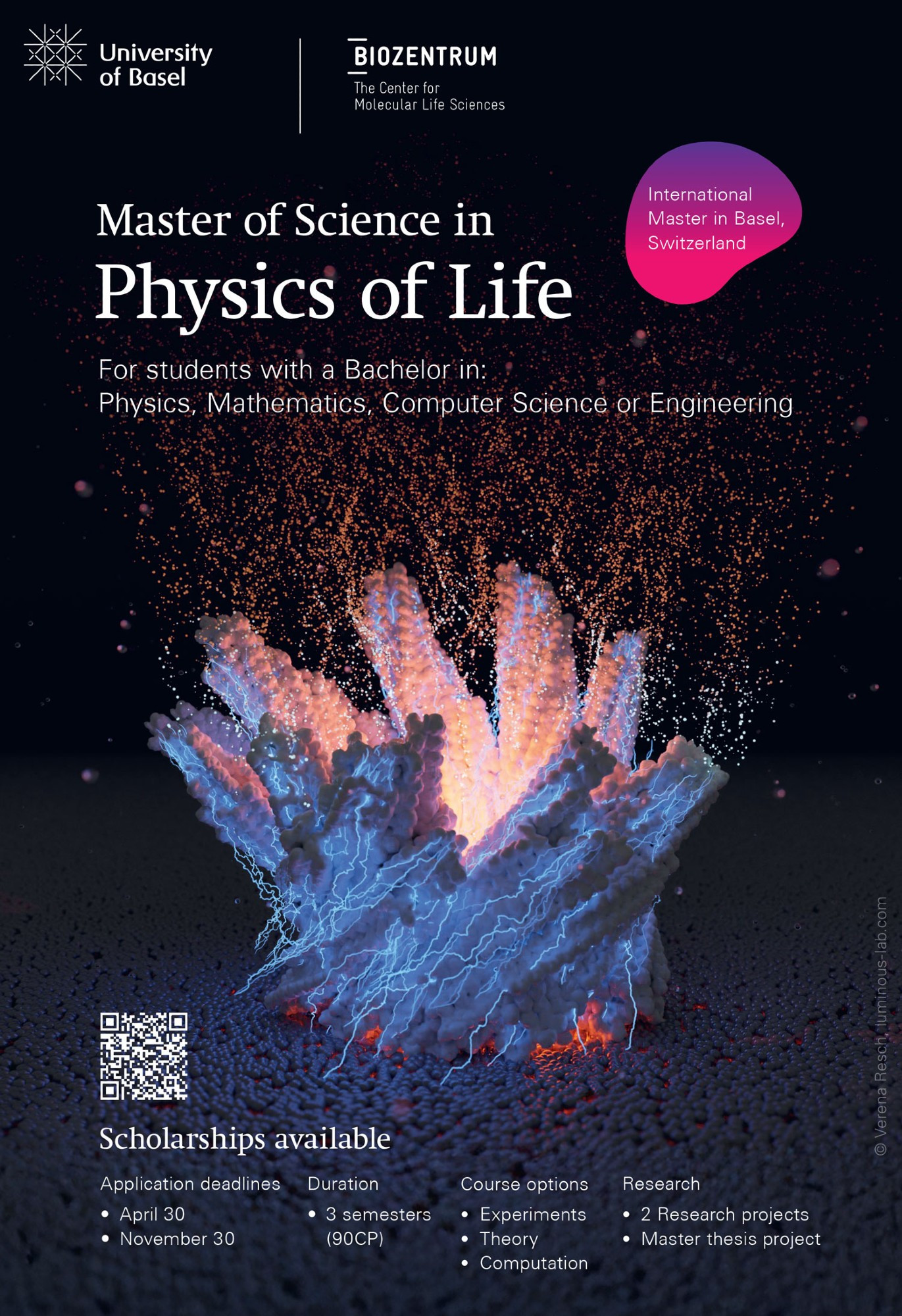
Apply now for our international Master of Science in Physics of Life @biozentrum.unibas.ch @unibasel.ch! Scholarships available.
More information: www.biozentrum.unibas.ch/education/de...
#Master #Students #Research #Physics #Mathematics #ComputerScience #Engineering #Basel #Switzerland