77 headless skeletons in a 7,000-year-old Neolithic ditch in Slovakia — carefully decapitated, freshly deposited, and missing their skulls entirely. Not a massacre. Something more complicated. #Neolithic #LBK #Archaeology www.anthropology.net/p/the-missin...
Brain removal, whittled bones, and a 265km genetic network: a reanalysis of two Iron Age burials in northern Scotland reveals mobile kin, distant Orcadian relatives, and funerary practices stranger and more deliberate than almost anything else from the period. @antiquity.ac.uk #IronAge #AncientDNA
New geochemistry study traces 780,000-year-old basalt handaxes & cleavers at Gesher Benot Ya’aqov to specific flows, including ones now buried. Cleaver makers went to different sources than handaxe makers. Deep knowledge, long tradition. #Acheulian #Paleoanthropology #LithicTechnology
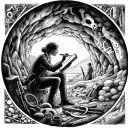
A cave in northern Spain required visitors to crawl 13m through total darkness to reach it. People did this from the late Ice Age to the Iron Age, 11,000+ years of return visits, each generation adding its own marks to the walls. #Paleoanthropology #RockArt #Archaeology
A crumbling 2nd-century stone monument in Campeche just rewrote Maya history. New 3D scanning reveals what may be the earliest Long Count date in the Maya lowlands — and it’s linked to a specific king’s accession. Calendar as political tool. #MayaArchaeology #AncientMaya #Mesoamerica
Late Postclassic Maya pilgrims kept returning to cities abandoned for centuries, resetting broken stelae and leaving incense burners. New excavations in Belize found the region’s first documented Postclassic altar. #Archaeology #MayaArchaeology www.anthropology.net/p/pilgrim-ci...
Eleven finely made stone bifaces, never used, buried in Ohio — and nobody knows why. A new study on the Joshua Cache shows how much a single find can reveal, and how little it can prove. #Archaeology #EasternWoodlands #LithicTechnology www.anthropology.net/p/eleven-bla...
New evidence from South Africa’s Wonderwerk Cave pushes hominin fire use back to ~1.79 million years ago — and introduces a luminescence method that makes ancient burning detectable in the field. #Paleoanthropology #Acheulean #HumanEvolution www.anthropology.net/p/fire-in-th...
Ancient Japanese dental calculus just got interesting: researchers found that Edo-period women who practiced ohaguro (tooth blackening) harbored a distinct lineage of an oral archaea, possibly shaped by the iron-rich cosmetic paste. #Anthropology #AncientDNA #OralMicrobiome
Bronze Age cremation nearly erased the biological record of the dead — but microscopic growth lines inside tooth roots survived the pyre. New research shows they can still estimate age, and may even carry information about diet and environment. #Paleoanthropology #BronzeAge #Bioarchaeology
Anthropology.net
Anthropology.net
Anthropology.net
Anthropology.net
Anthropology.net
Anthropology.net
Anthropology.net
Anthropology.net
Anthropology.net
Anthropology.net
www.anthropology.net
How Sala Keimada, hidden inside one of Europe’s longest karst systems, became a sanctuary people returned to for more than eleven thousand years
New analytical evidence pushes the cave’s fire record back to 1.79 million years ago, and introduces a technique that may change how archaeologists look for ancient burning.
www.anthropology.net
What two Iron Age individuals buried on Scotland’s northern coast reveal about mobility, kinship, and what the living did with the dead
A second-century monument at El Palmar pushes back the earliest known Long Count date by more than a century — and reveals something stranger: a ruler who weaponized the calendar itself
www.anthropology.net
A microscopic technique survives the funeral pyre — and may carry more information than anyone expected