Postdoc at the Schuller Lab - Synmikro Marburg 🇩🇪
Cryo-EM/ET of anaerobic CO₂ fixation
Tomas Pascoa
Loading...
Thrilled to share the updated video of my paper in Nature with Maciej (under supervision of @simonemattei.bsky.social & @jomaalab.bsky.social) Proud to use Cryo-ET to uncover how hibernation factors are key to translation restart! To model PTMs in situ and render animations fulfilled my PhD dream!🥹🎉
Video
Big news for correlative cryogenic SMLM/ET! With my colleague Soheil, we (Mahamid and @jonasries.bsky.social labs) indicate lamella-specific illumination can allow 500-1500x higher laser intensities, opening massive new possibilities for correlative imaging #teamtomo
www.biorxiv.org/content/10.6...
Higor Rosa
Video
See also our preprint about the microscope itself, which went up earlier this afternoon!
www.biorxiv.org/content/10.6...
We @embl.org wrote a short preprint about optimizing for maximum completeness in #cryoet analysis. We looked at template matching, VPP imaging, and tilt-series refinement parameters, and why averaging ribosomes helps even if you aren’t interested in their biology 🏭
www.biorxiv.org/content/10.6...
Despite its name, SNOR, a newly discovered protein, is hardly asleep on the job.
EMBL researchers’ newest technologies allowed their scientific collaboration to discover a tiny protein with a big role in awakening cells from dormancy to restart protein synthesis.
www.embl.org/news/science...
Amazing paper. A megadalton enzyme complex that:
- combines both electron bifurcation AND confurcation steps
- has a new type of iron-sulfur cluster
- a new kind of weird electron transfer path
- super charges electrons to reduce aromatic rings
- also powers respiration
😳
joe dobbs
Oxygen gradients reshape cross-feeding through emergent spatial organization of gut commensal bacteria
www.biorxiv.org/content/10.6...
Use of isotope labels and cryo-CLEM-FIB-SIMS to study microbial communities by Hannah Ochner. Collaboration with @kiranrpatil.bsky.social @jmghigolab.bsky.social
Mother Nature is still the undisputed Queen of organic chemistry!
Preprint 🧵!
I’m really excited to introduce BIGSMALL, an interleaved multi-magnification cryo-ET scheme bridging molecular and cellular scales in a single acquisition!
BIGSMALL = 𝐁road 𝐈nformation 𝐆athering 𝐒trategy by 𝐌ultiscale 𝐀cquisition of lame𝐋𝐋a
www.biorxiv.org/content/10.6... (1/6)
www.biorxiv.org
Newly identified protein, SNOR, seems to help cells in a starvation-induced dormancy restart protein synthesis once nutrients are available.
How do “LEGO-like” electron-bifurcating modules combine to drive degradation in BTEX-contaminated ecosystems?
Check out our latest preprint, where we use cryo-EM and cryo-ET to reveal how the 1 MDa BCRII complex powers extremely endergonic aromatic ring reduction.
www.biorxiv.org/content/10.6...
joe dobbs
joe dobbs
EMBL
Microbial interactions unfold within environments structured by physical transport and chemical gradients. Yet most mechanistic studies rely on well-mixed systems that mask the reciprocal influences of environmental heterogeneity on metabolism and ecology. Here, we investigate how the physical environment modulates the interaction between the gut commensal Bacteroides thetaiotaomicron and Escherichia coli . In anoxic liquid culture, cell-resolved isotope imaging and genetic perturbations reveal exploitative cross-feeding, where E. coli consumes diffusible sugars released by B . thetaiotaomicron during starch degradation. When exposed to intestinal-like oxygen gradients in microfluidics, the interaction is restructured by spatial organization. The species self-organize into complementary niches: E. coli locally depletes sugars and oxygen, thereby expanding the anoxic niche required by B. thetaiotaomicron . A reactive transport model confirms that this organization arises from coupled feedback between physical transport and metabolic reaction rates. Together, our results reveal how physical structure and chemical gradients convert an exploitative cross-feeding interaction into a dynamic niche-construction process that generates emergent spatial organization and stabilizes coexistence. ### Competing Interest Statement The authors have declared no competing interest.
It's out! 🥳
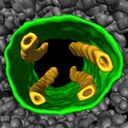
In situ architecture of #plasmodesmata - plant cytoplasmic bridges - by #cryoET.
📝 Paper: www.nature.com/articles/s41...
🧵 Thread: bsky.app/profile/madi...
#teamtomo #proteomics #AlphaFold
James Lingford
www.biorxiv.org
Tanmay Bharat
Lars-Anders Carlson
Helena Watson
Across scales from cells🦠 to atoms⚛️ – We reveal how anaerobic #bacteria break down very stable aromatic compounds found e.g. in oil spills 🛢️ #Bioremediation #TeamTomo 🧪 🧶🧬 🔬
Awesome collab with Lena, Matthias, @schullerjm.bsky.social @rnfr2d2.bsky.social @tomaspascoa.bsky.social @tamb-o.bsky.social
Anuj
1/ Excited to share our preprint! 🥳
Degradation of aromatic compounds, including BTEX pollutants, requires highly endergonic aromatic ring reduction. Using #cryoEM and in situ #cryoET, we show how BCRII couples electron bifurcation modules in one giant redox machine
www.biorxiv.org/content/10.6...
Using cryo-electron tomography, the authors reveal how plasmodesmata (plant cytoplasmic bridges) are gated by cell wall remodelling and how helical protein assemblies scaffold internal membranes, with...
New preprint: In situ Architecture of #Plasmodesmata.
Using #cryoET, #AlphaFold & proteomics, we uncover the native organization of plant intercellular nanopores.
🔗 doi.org/10.1101/2025...
🧪🧵1/n
#teamtomo #PlantScience #Physcomitrium #Arabidopsis #cryoEM
1/ Excited to share our preprint! 🥳
Degradation of aromatic compounds, including BTEX pollutants, requires highly endergonic aromatic ring reduction. Using #cryoEM and in situ #cryoET, we show how BCRII couples electron bifurcation modules in one giant redox machine
www.biorxiv.org/content/10.6...